
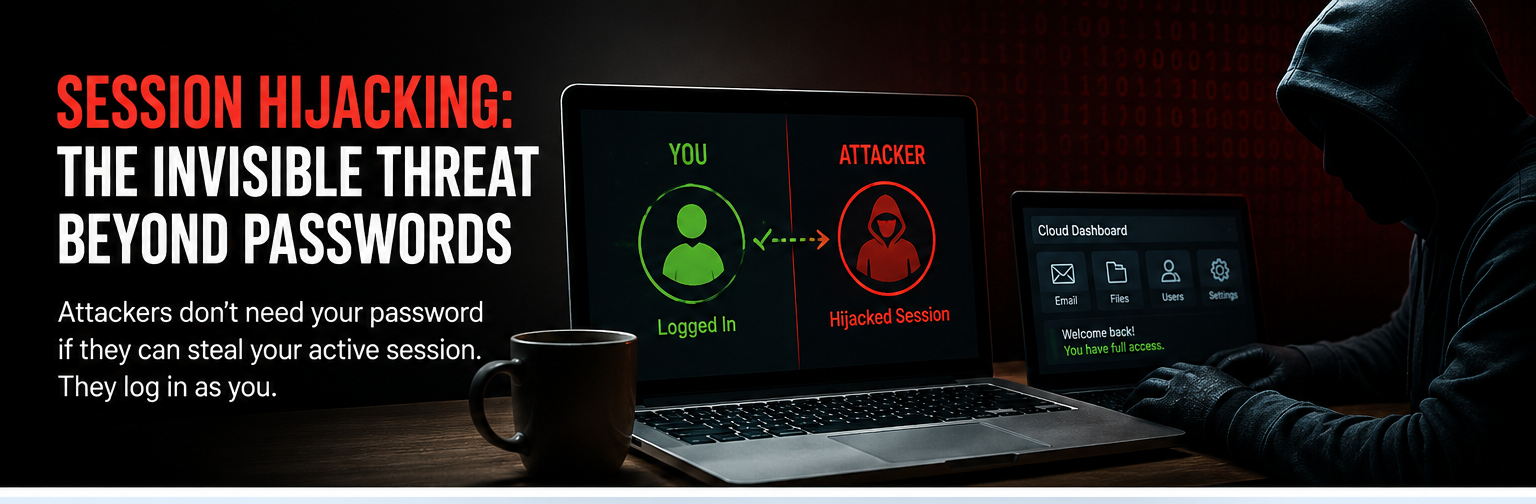
Most businesses believe they are secure once they enforce strong passwords and Multi-Factor Authentication (MFA). While these are critical security measures, cybercriminals are increasingly targeting something else: active browser sessions.
In simple terms, attackers may not need to crack your complex password or intercept your OTP code if they can steal the digital "pass" your browser receives after you successfully log in. With SaaS adoption skyrocketing across Nigeria, session hijacking represents one of the fastest-growing pathways to corporate cloud compromises.
Quick Take
Attackers don't always need your password. If they can steal a valid authenticated browser session, they can bypass multi-factor authentication (MFA) entirely and access your company's systems without triggers.
What Is Session Hijacking?
When you sign in to Microsoft 365, Google Workspace, your corporate banking portal, or any cloud application, the system creates an active session. In the background, a unique digital cookie or token is placed inside your browser. This keeps you logged in, allowing you to navigate the application and perform business tasks without repeatedly entering your credentials or completing security checks.
Session hijacking occurs when an attacker steals that active session token and imports it into their own browser. Because the target application sees a valid, already-authenticated token, it assumes the request is coming from the legitimate employee. The attacker is immediately granted entry, completely bypassing login credentials and MFA prompts.
Understanding Security: The Visitor Badge Analogy
Password = Key
The specific security credential used to enter the digital building.
MFA = Security Guard
The additional verification layer checking your physical identity.
Session = Visitor Badge
The authenticated badge that lets you roam free inside without checks.
The Threat: If a malicious actor steals that authenticated "Visitor Badge" from your desk, they don't need the key or to face the security guard. They can move around restricted sections as if they were you, undetected.
Why MFA Alone Is Not Enough
Multi-Factor Authentication (MFA) remains one of the single most effective baseline cybersecurity controls available. It prevents 99.9% of automated credential stuffing and bulk brute-force campaigns. However, standard MFA primarily secures the point of authentication—the front gate.
Once that gate is open and a session is created, the verification process finishes. The cloud service assumes that anyone presenting the valid cookie has already satisfied the MFA requirements. If an attacker intercepts the session cookie afterwards, the system has no reason to re-verify their identity.
Security Insight
MFA protects authentication, but organizations must also protect authenticated sessions, endpoints, browsers, and network access after login. Counting solely on standard MFA leaves an open window for modern adversary-in-the-middle (AiTM) phishing tools.
For Nigerian businesses operating with remote talent, public Wi-Fi networks, or hybrid workforce setups, this gap in protection is increasingly being exploited. Local threat intelligence reports highlight that session hijackers frequently exploit this exact assumption.
How Attackers Steal Sessions
Cybercriminals have designed highly sophisticated methods to acquire these active tokens without needing complex server-side breaches. Understanding these pathways is crucial for maintaining resilient business cybersecurity in Nigeria.
Common vectors include:
-
Phishing & AiTM Frameworks Using proxies to sit between user and actual server, passing MFA through while copying the resulting session cookie.
-
Info-Stealing Malware Malicious software infecting the host endpoint that specifically searches for browser profile folders to extract active cookies.
-
Malicious Extensions Innocent-looking browser extensions downloaded by employees that have hidden permissions to read web session states.
-
Compromised Endpoints Unmanaged personal devices used to access business data that lack advanced endpoint security defenses.
Once attackers successfully extract session tokens, they move swiftly. They bypass standard defenses to target:
Anatomy of a Session Hijacking Attack
Hover or tap on each stage of the attack path to see how hackers breach modern company environments.
Login Attempt
User performs a routine login, passes standard passwords and MFA gates.
Session Cookie
The system issues an authenticated active browser cookie to prevent constant logouts.
Session Theft
Attacker steals the cookie payload via malware, phishing proxy, or suspicious extensions.
Full Account Access
Attacker imports the cookie. System grants instant business-wide access bypassing MFA.
Hover or tap on any stage of the diagram above to analyze the attacker's operational path and security vulnerabilities.
How Nigerian Businesses Can Protect Themselves
Securing hybrid business assets in Nigeria requires moving from simple point-in-time perimeter authentication toward continuous, context-aware cybersecurity practices.
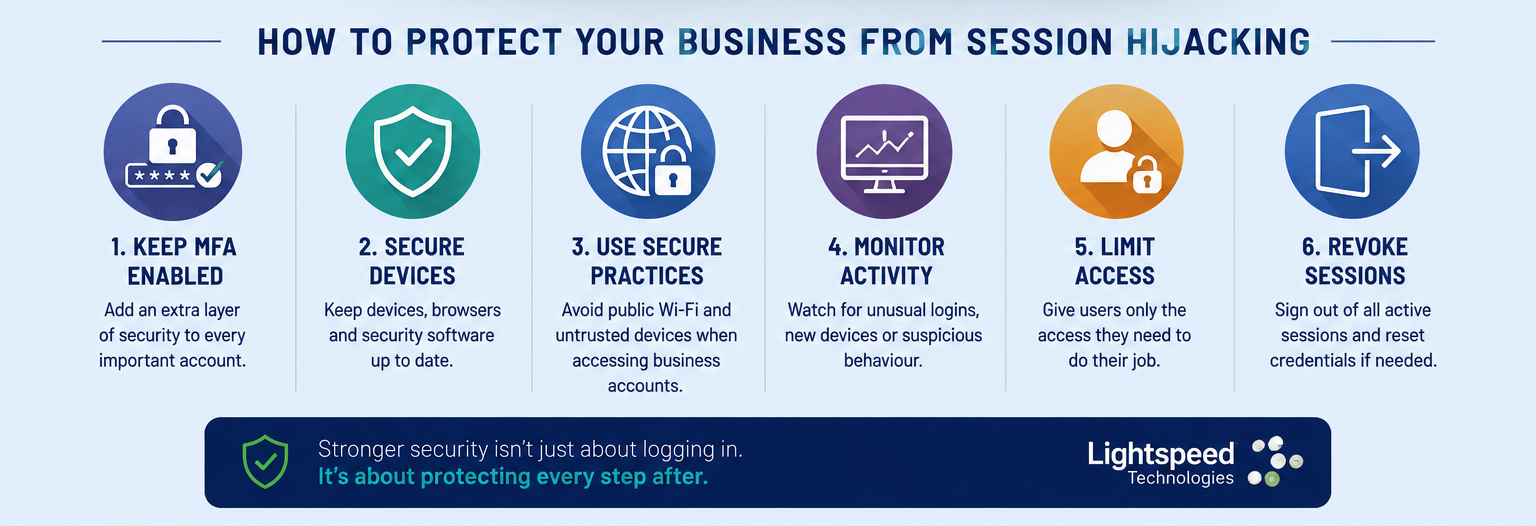
Here is a robust, premium security framework optimized for Nigerian enterprises utilizing SaaS, ERPs, and collaborative platforms:
Keep MFA Enabled
MFA remains foundational. While it can be bypassed post-login, it prevents automated credential stuffing. For highly critical directories, transition from basic SMS or authentication app codes to phishing-resistant FIDO2 hardware keys or hardware-bound device states.
Secure Employee Devices
Cookie theft requires access to the browser environment. Enforcing automatic operating system and browser updates, coupled with premium endpoint protection (MDR/EDR), blocks malware from scanning the browser's data caches. Use IT support for businesses to manage and audit corporate endpoints remotely.
Use Secure Browsing Practices
Ban employees from logging into company instances from unmanaged personal devices or over insecure public Wi-Fi networks without an enterprise VPN. Restrict browser extensions to a pre-approved security whitelist.
Monitor Account Activity
Leverage conditional access analytics. Flag anomalies like "Impossible Travel" (e.g., logging in from Lagos and 15 minutes later from London via a hijacked session session token IP) or logins from unexpected device fingerprints.
Limit User Access
Minimize damage by employing the Principle of Least Privilege (PoLP). Employees should only possess access scopes necessary for active job functions. If an entry token is compromised, the attacker's blast radius is strictly contained.
Revoke Suspicious Sessions Quickly
When anomalies are spotted or an employee reports device loss, use cloud administrator panels (like Azure/M365 Admin Center) to instantly revoke all active session cookies, forcing global re-authentication with MFA.
Interactive Security Readiness Checklist
Assess your organization's defenses against post-login and session-based attacks. Tap boxes to evaluate:
The Bottom Line
Strong passwords and multi-factor authentication (MFA) are no longer a foolproof shield on their own. As modern cyber threats shift focus from hacking passwords to stealing active, authenticated browser sessions, the standard definitions of safety are changing.
For Nigerian businesses depending daily on cloud portals, business applications, and SaaS systems, protecting active browser sessions is just as critical as password management. A truly resilient business security framework combines:
The Optimal Protection Formula
Effective modern cybersecurity is no longer just about establishing rules to keep attackers outside. It is about deploying automated safeguards that detect, isolate, and stop malicious actors even after a correct login has occurred.
Need Help Securing Your Business?
Strengthening endpoint boundaries and securing transient browser cookies requires structured IT expertise. At Lightspeed Technologies, we collaborate directly with Nigerian businesses to shore up hybrid architecture, configure resilient access management, and stop threat actors before they exploit session gaps.
Our specialized, industry-leading technical services include:
Advanced Cloud Security
Configuration of secure identity platforms, session lifetime controls, and robust conditional access in Microsoft 365 and Google Workspace.
Endpoint & Device Protection
Deploying Managed Detection and Response (MDR) layers to prevent credentials, browsers, and cookie caches from hostile extractions.
Proactive IT Support & Consulting
Continuous network monitoring, fast remote remediation of sessions, and strategic design tailored to your organization's business needs.
Security Assessments
Thorough audits of directory settings, employee behaviors, VPNs, and risk policies to detect session-hijacking vulnerability doors.
Frequently Asked Questions
Is Your Business Protected Beyond the Login Screen?
Protect your business before attackers exploit the gap between login and access. Lightspeed Technologies can help you strengthen endpoint security, cloud security, access controls, and your overall cybersecurity posture.
This is incredibly spot on. We literally just caught an AiTM phishing attempt last month in Lagos that targetted our financial controllers. Had we not implemented physical security key bindings (MFA), the session token compromise would have allowed full access to our M365 environment. Standard OTP wouldn't have saved us. Thank you for raising awareness about session security!
Reducing browser idle timeouts inside corporate panels is such a simple yet heavily neglected safety step here in Nigeria. Most local businesses leave webmail logged in on staff laptops for weeks. If they catch a cookie-stealing malware strain, the attackers gain long-term persistence immediately. Appreciate the structured, clear solutions.